

PT-141 for men is the answer to a problem most men confuse with something else. In the book, I put it this way: Viagra works on your genitals, while PT-141 works on your brain. It’s the melanocortin peptide in Chapter 13, at 1 to 2 mg, 45 to 60 minutes before sex, and it creates a primal, aggressive arousal. This page covers what the book says, what the trials show, and the rules the book doesn’t spell out: how often you can use it, why the nasal spray is a different dose, and what it does to your blood pressure.
PT-141 is the research name for bremelanotide, a lab-made peptide based on alpha-MSH. In turn, alpha-MSH is a hormone your brain uses to signal arousal, appetite and skin pigment. PT-141 activates melanocortin receptors, mainly MC1 and MC4 [1].
MC4 receptors sit in the hypothalamus, the part of the brain that runs desire, and that is where the arousal comes from. MC1 receptors, on the other hand, sit in the skin, so that’s why PT-141 can darken skin over time.
It started from Melanotan II, the tanning peptide. Then, in early trials, the men noticed a side effect: arousal. Researchers built PT-141 from it to keep that effect [2].
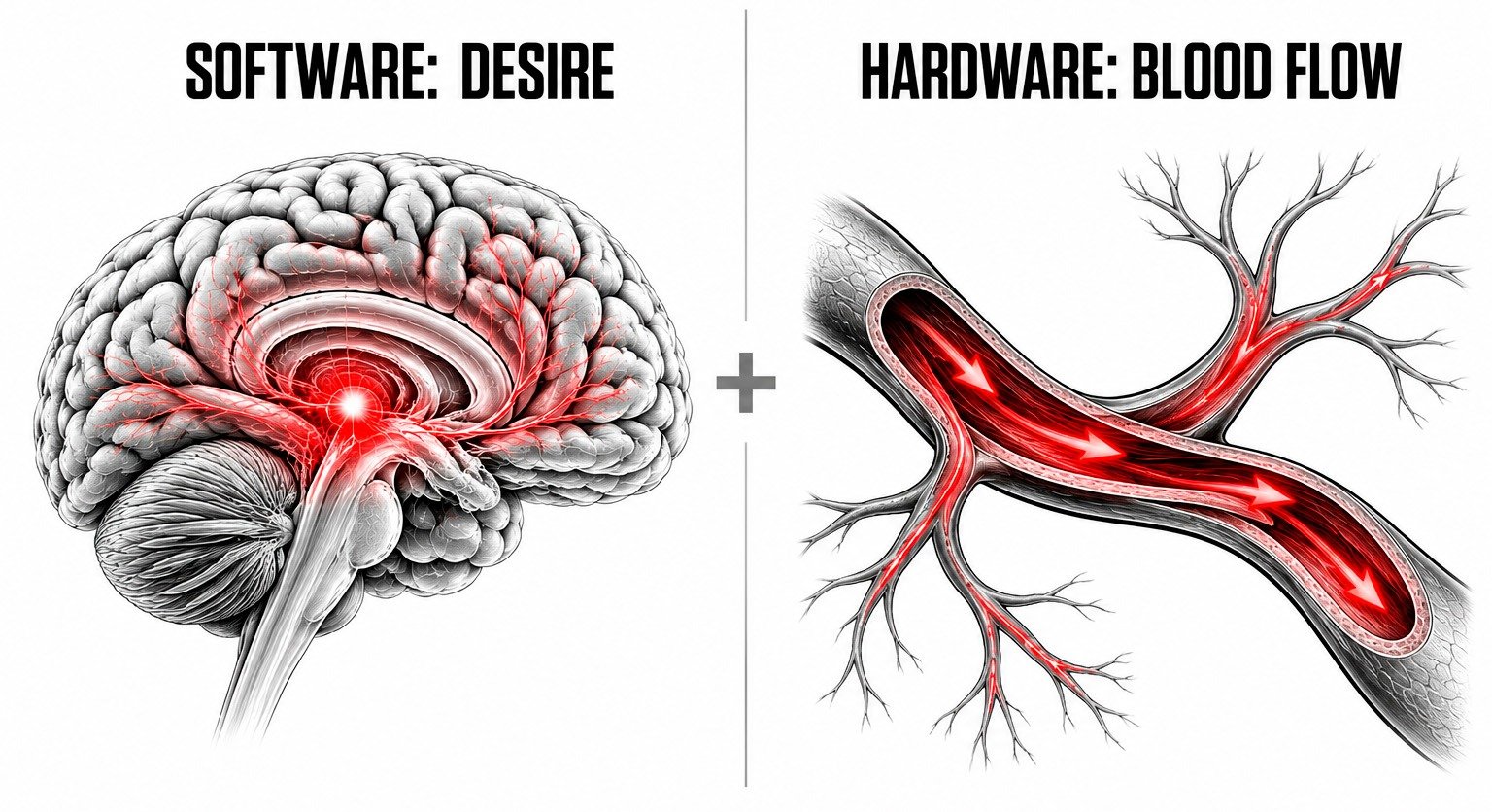
Chapter 13 splits sexual function in two. Hardware is blood flow, nitric oxide and penile tissue. Software is the drive: neurotransmitters and receptor sensitivity.
Still, most men treat a software problem with hardware. In the book’s words, taking Cialis when your dopamine is low gives you a functional erection with zero desire to use it. You have to engineer both.
Therefore, PT-141 for men sits on the software side. In Chapter 13, it’s the first desire pathway, the melanocortin pathway, which the book calls “The Hunter.” Chapter 3 uses it as the example of a chemistry problem with a chemistry answer: low libido with high testosterone gets PT-141 combined with the oxytocin stack.
In men. The book cites a 2004 trial of PT-141 as a nasal spray in healthy men and in men with erectile dysfunction. It produced erections, the first starting about 30 minutes after the dose, with flushing and nausea as the main side effects [3]. In 2008, however, the nasal program for sexual dysfunction stopped after the FDA raised concerns about blood pressure spikes [4].
In women. The injection came back and was approved in 2019 as Vyleesi, for premenopausal women with low sexual desire. In two 24-week trials, it raised desire and lowered distress about low desire compared with placebo [5]. However, it didn’t increase the number of satisfying sexual events [6]. That’s the honest picture: it moves desire, the thing it targets.
Overall, the trials in men were short, and the approved drug is for women. Everything a man does with PT-141 is off-label.
Below is the PT-141 dose table, injection vs nasal spray, the frequency rules, blood pressure, side effects, interactions and the full desire stack.
The PT-141 dose table, injection vs nasal spray, the frequency rules, blood pressure, side effects, interactions and the full desire stack are for members. Create your free account to keep reading.
When you create your free membership, you’ll unlock the full article and be able to continue reading.
Already a member?
This page documents Dr. Tony Huge’s research and self-experimentation. It is journalism and education, not medical advice, and it creates no doctor-patient relationship. Dr. Tony Huge holds a Juris Doctor; he is a lawyer, not a physician. Read the full Legal Disclaimer.