
Caffeine half-life is the number most people never think about, and it’s the reason their sleep is broken. In my Sleep Bible, caffeine is the first thing I name when I explain what destroys sleep pressure. The half-life is 5 to 7 hours, so that 2 PM coffee still has about half its strength at 9 PM. This page gives you a cutoff table for your bedtime, the dose that actually helps your training and the rules for caffeine in a fat-loss stack.
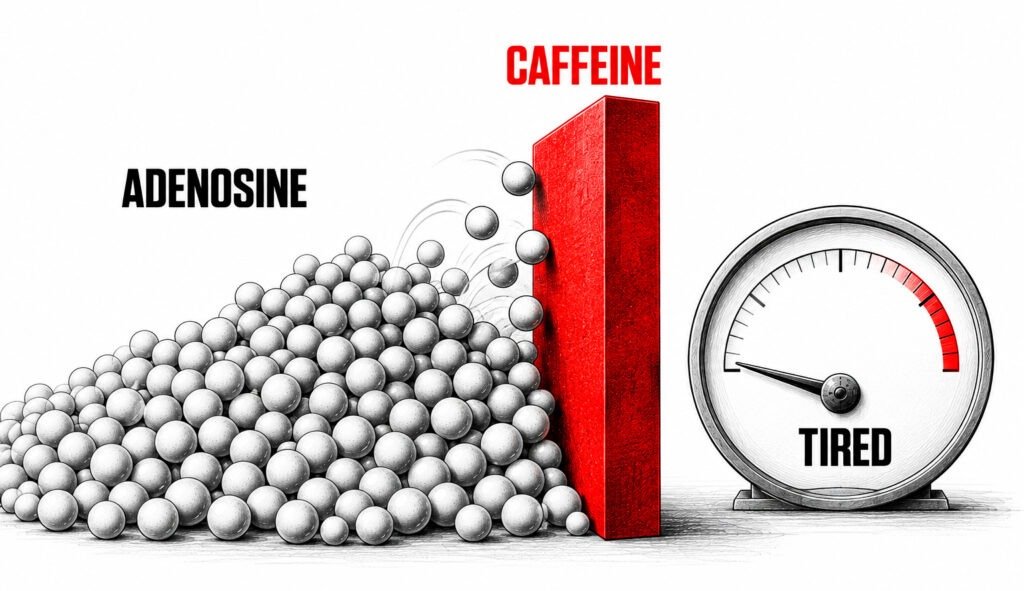
From the moment you wake up, your brain builds up adenosine. It’s the exhaust of a working brain. The longer you’re awake, the more of it there is, and the stronger the pull toward sleep. In the Sleep Bible, I call this sleep pressure.
Caffeine works by blocking the receptors that adenosine binds to. So the adenosine keeps piling up behind the wall, but your brain can’t read the signal. It’s like putting tape over your check engine light.
Then the caffeine wears off, and the whole load hits you at once. That’s the crash. And if the caffeine is still in your system at bedtime, it blunts the sleep pressure you spent the whole day building.
Half-life means the time it takes your body to clear half of a dose. For caffeine, the book uses 5 to 7 hours. In other words, every 5 to 7 hours, what’s left in your blood drops by half.
So caffeine keeps working long after you stop feeling it. A 2 PM coffee still has about 50% of its blocking power at 9 PM. And that 4 PM pre-workout is still in your system at 11 PM.
The sleep research backs this up. In a 2013 study, healthy adults took 400 mg of caffeine at bedtime, 3 hours before or 6 hours before. Every timing disrupted sleep. Even at 6 hours before bed, caffeine cut total sleep by more than an hour on the sleep monitor. Most surprising of all, people didn’t notice it in their own sleep diaries [1].
That’s the trap of caffeine half-life. You don’t feel the damage, so you never connect it to your bad nights.
Below is the cutoff table for your bedtime, how to know if you’re a slow metabolizer, the training dose and the stimulant rules for fat loss.
The cutoff table for your bedtime, fast vs slow metabolizers, the training dose, the fat-loss stimulant rules, what slows caffeine down and who should cut it are for members. Create your free account to keep reading.
When you create your free membership, you’ll unlock the full article and be able to continue reading.
Already a member?
This page documents Dr. Tony Huge’s research and self-experimentation. It is journalism and education, not medical advice, and it creates no doctor-patient relationship. Dr. Tony Huge holds a Juris Doctor; he is a lawyer, not a physician. Read the full Legal Disclaimer.